

Keywords
pharmaceutical preparations
validation studies
rheology
How to Cite
Abstract
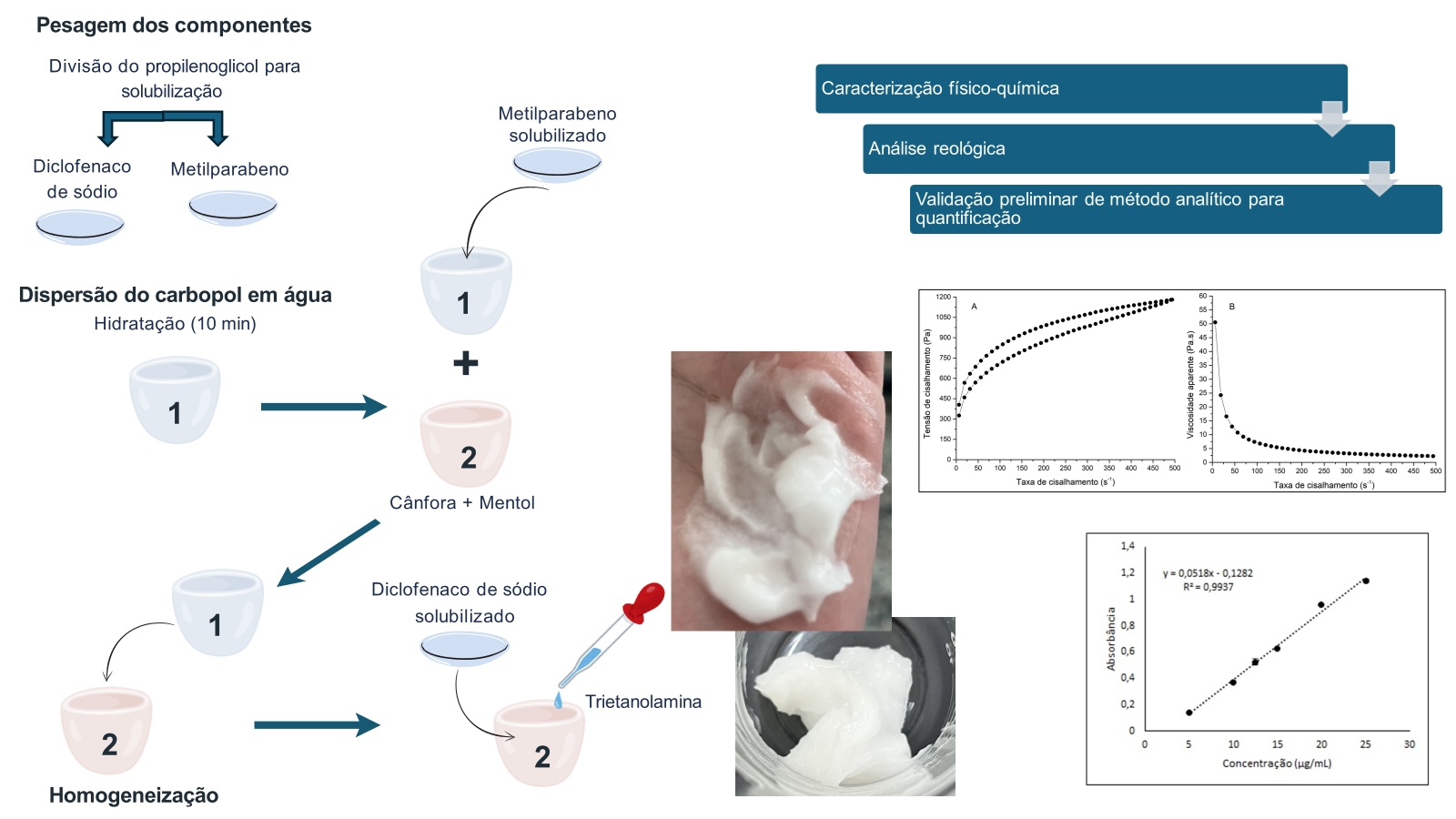
Sodium diclofenac is a non-steroidal anti-inflammatory drug widely used in the treatment of inflammatory and painful processes, with topical application being an effective and safe alternative, since it reduces systemic adverse effects. This study aimed to develop and characterize a semi-solid formulation (gel) containing 1% (w/w) sodium diclofenac, as well as to preliminarily validate a UV spectrophotometric method for its quality control. The formulation was evaluated in physicochemical tests (pH and density), stability by centrifugation, and rheological analysis. During the preliminary validation, the parameters of selectivity, linearity, precision, accuracy, limits of detection and quantification were evaluated. The gel presented a pH compatible with the skin (6.17), a density of 1.03 g/cm³, adequate physical stability, and Herschel-Bulkley fluid behavior (pseudoplastic profile with flow limit) and thixotropic behavior, both favorable for topical application. The UV spectrophotometric method for quality control of diclofenac sodium in semi-solid formulation proved to be selective, linear in the range of 5.0 to 25.0 μg/mL (R² = 0.994 and R = 0.997), precise (RSD ≤ 5%) and accurate, with average recovery between 97 and 103%. The limits of detection and quantification were 1.09 μg/mL and 3.31 μg/mL, respectively, and the diclofenac sodium content in the gel was 98.5%, within the acceptable range (90-110%). Thus, the developed formulation presented satisfactory quality, and the analytical method developed for the quantification of diclofenac sodium in gel proved to be simple, low-cost and promising for routine analyses, ensuring the reliability of quality control of topical diclofenac sodium formulations.