

Keywords
bioavailability
solid dispersion
drug solubility
amorphysation
amorphous substances
How to Cite
Abstract
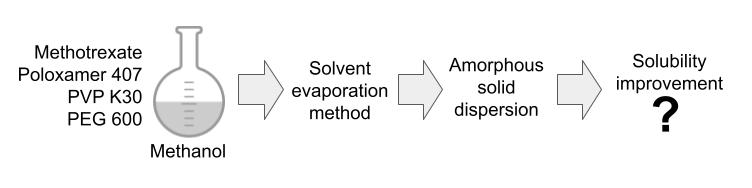
Introduction: Methotrexate (MTX) is a widely used drug for autoimmune diseases and cancers, but suffers from low oral bioavailability due to its poor solubility and permeability. Objective: This study aimed to enhance MTX solubility by developing amorphous solid dispersions using Poloxamer 407, PVP K-30, and PEG 6000 through solvent evaporation. Methods: The dispersions were characterized using DSC, PXRD, and FTIR to confirm amorphization, and their solubility was tested in a pH 6.8 phosphate buffer compared to free MTX. Results: The results showed that amorphization was successfully achieved, as confirmed by PXRD analyses and supported by DSC and FTIR findings. However, the amorphous solid dispersions did not improve MTX solubility over the free drug, consistent with previous studies indicating minimal solubility gains for MTX in both amorphous and crystalline forms. These findings suggest that amorphization alone may be insufficient to enhance MTX solubility. Conclusions: The study concludes that MTX amorphous solid dispersions are technically feasible but do not offer significant solubility benefits. Alternative strategies, such as nanoencapsulation, may be more promising for improving MTX bioavailability. These results underscore the need for innovative approaches in MTX delivery systems to overcome its inherent limitations.