

Keywords
wound healing
garlic
broccoli
Caco-2
HT-29
How to Cite
Abstract
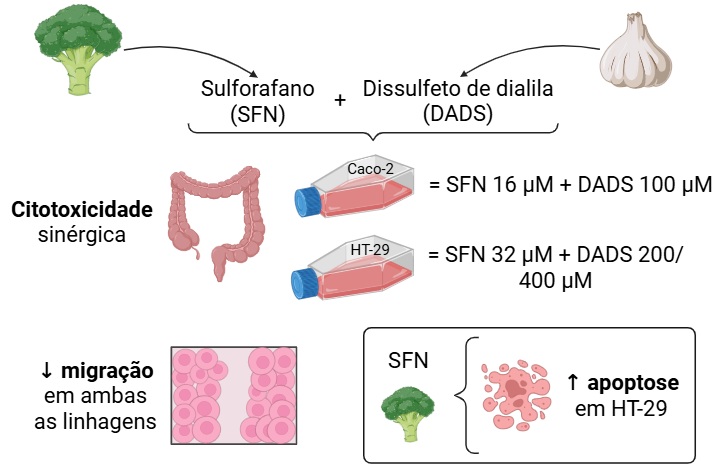
Colorectal cancer (CRC), which comprises cancer of the colon and/or rectum, is the third most commonly diagnosed type of cancer. Due to the occurrence of adverse effects and drug resistance, there is a need to find more effective treatments for CRC. Nutraceuticals regulate various metabolic pathways can modulate multiple biomarkers in cancer cells. The present study examined whether diallyl disulfide (DADS) and sulforaphane (SFN), either alone or in combination, were cytotoxic to human colon cancer cells. We assessed DADS (25-800 µM) and SFN (2-32 µM) effects on cell viability (resazurin assay), cell migration (wound healing), and apoptosis (flow cytometry) in human colon adenocarcinoma cells (Caco-2 and HT-29). Synergistic, additive, and antagonistic effects were determined by the combination index (CI) method. The treatment with SFN alone in high concentration reduced cell viability and suppressed cell migration in both cells. The DADS + SFN combination exerted synergistic effects in reducing cell viability in HT-29 cells. The DADS + SFN combination is a promising preclinical strategy for evaluating new therapy systems targeted at CRC.