

Keywords
Plant Extracts
Zingiber officinale
Bambusa
Gels
How to Cite
Abstract
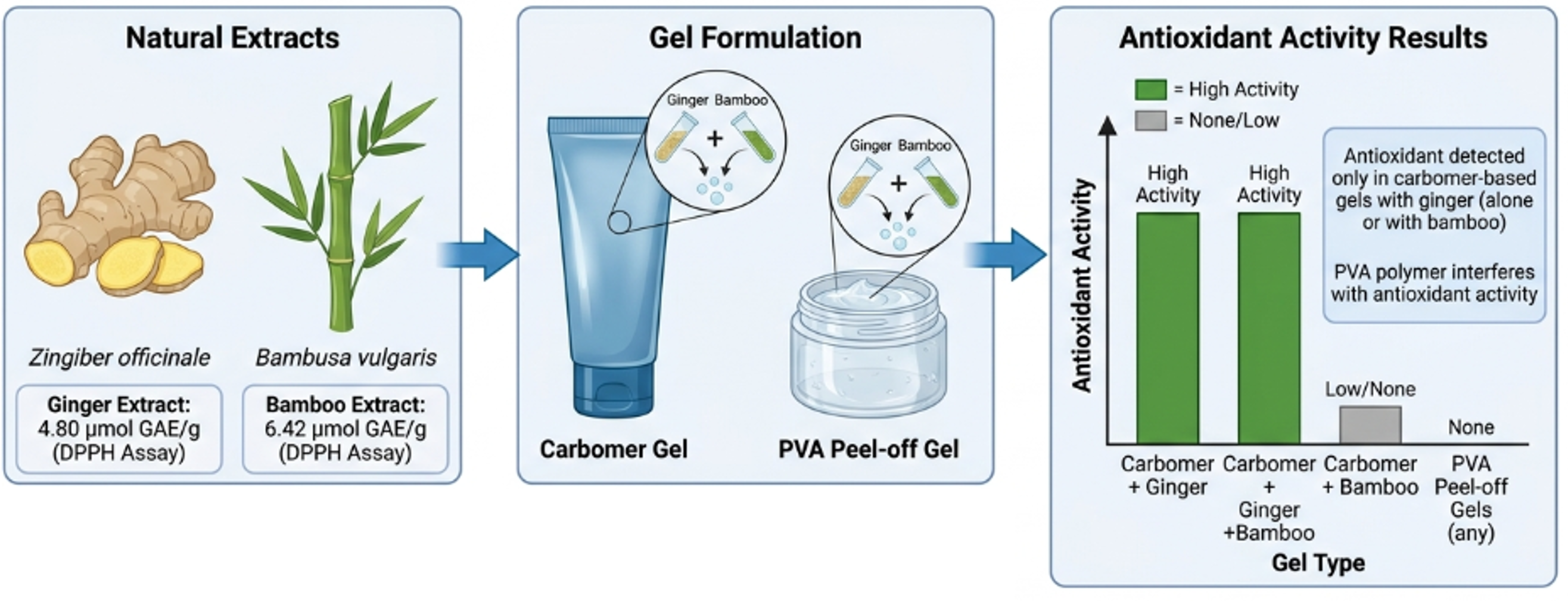
The growing demand for natural cosmetics has encouraged research into botanical active ingredients with antioxidant properties. Ginger (Zingiber officinale) and bamboo (Bambusa vulgaris) extracts are promising candidates for cosmetic applications; however, their incorporation into formulations requires adequate assessment of stability and functional performance. This study aimed to develop and characterize cosmetic gels containing these plant extracts. Ginger and bamboo extracts showed antioxidant activities of 4.80 and 6.42 μmol gallic acid equivalents/g extract, respectively, as determined by the DPPH assay. Peel-off and carbomer-based gel formulations prepared with the extracts exhibited suitable organoleptic characteristics. However, only the carbomer-based gels containing ginger extract, alone or combined with bamboo extract, showed significant antioxidant activity. In contrast, the PVA-based peel-off gels showed no detectable antioxidant activity, suggesting possible interference of this polymeric vehicle with the antioxidant response. Although the formulations generally demonstrated adequate physical stability, the carbomer-based formulation containing the combined extracts showed the best overall performance, remaining stable for 30 days under all storage conditions (4 °C, 25 °C, and 40 °C). Overall, these findings highlight the importance of excipient selection in preserving the efficacy and stability of antioxidant cosmetic formulations.